
FOUNDER'S NOTE · BEHIND THE DESIGN
The 1 UVC Diode I Wasn't Supposed to Find
Why the Krypton uses 40-year-old Philips bulb technology instead of UV LEDs — and what one spectrometer reading taught me about how the market is really built.
By Kris Sweeting · Founder, EMR-TEK · 5 min read
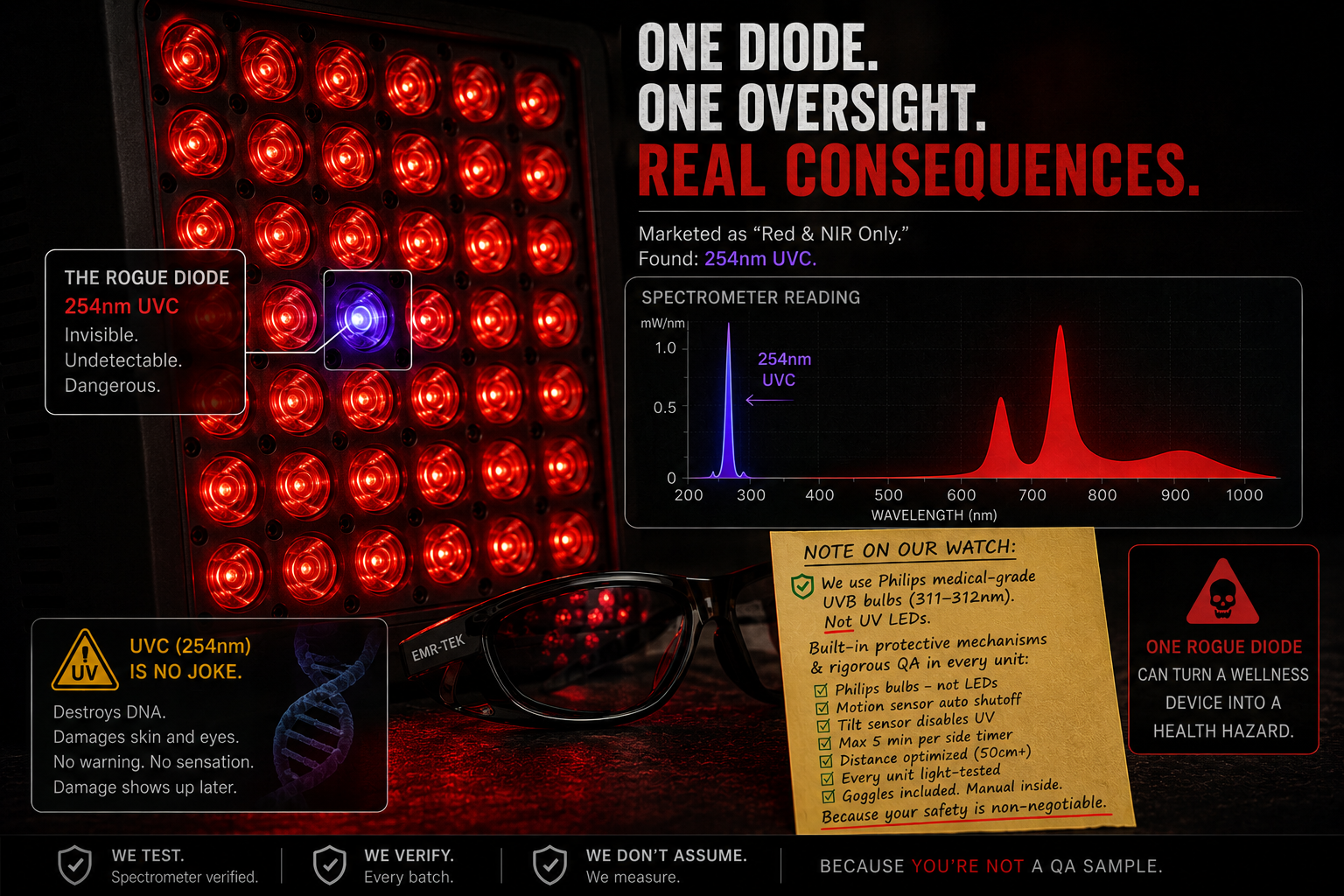
A few years back, someone on a forum I follow posted a spectrometer reading. Different brand's "red and near-infrared" panel. Not mine. Spec sheet said zero UV. Manual said zero UV.
The reading showed one UVC diode. 254nm. Unmistakable.
254nm is the wavelength hospitals use to sterilize surgical instruments. It shreds DNA on contact.
I know it better than most — I designed a robotic vacuum that uses 254nm UVC to sterilize surfaces around the house. It has motion sensors that shut it off the second a person or pet enters the room. That's the only responsible way to deploy UVC around living things.
Not on the box. Not in the manual. Just quietly there, on someone's face.
The person who caught it deserves credit — I owe whoever posted that reading more than I can say. But the moment I saw it, I made a decision: EMR-TEK would never touch UV LEDs.
· · ·
Why one rogue diode is not the whole problem
That device wasn't supposed to emit UV at all. It was marketed as red and near-infrared only. And somehow, one UVC diode made it through the manufacturing line, the QA sign-off, and the marketing copy without anyone catching it.
Now picture a company that's intentionally building UV LED devices. Panels with hundreds of UVA and UVB diodes. Batches produced weekly. Suppliers changing. Bins shifting.
What are the odds a UVC diode eventually ends up in the wrong slot?
Not high. Inevitable.
· · ·
What UVC actually does
Skin: UVC breaks nucleotide bonds in the DNA of your keratinocytes. Your cells try to repair. Some misrepair. Misrepaired DNA is how you get squamous and basal cell carcinomas. UVC is a Group 1 carcinogen for a reason.
Eyes: The cornea absorbs almost all incoming UVC. Overexposure causes photokeratitis — a sunburn on the surface of the eye. Symptoms appear 6 to 12 hours later. Chronic exposure is linked to cataracts.
The kicker: 254nm UVC is invisible. It doesn't feel warm. It doesn't feel bright. You do not know you've been overexposed until the damage shows up hours or days later.
· · ·
Why LEDs are the wrong tool for this job
LEDs shift wavelength over time. That drift is called spectral migration. A "660nm" LED might peak at 655nm on day one and 641nm by year three, as the semiconductor junction degrades from thermal cycling.
Two LEDs from the same wafer can also have peak wavelengths 5–10nm apart. Manufacturers "bin" them and sell each bucket at different price points. Cheaper devices use wider bins.
For red light, this is manageable. Quality drivers (we use Meanwell on every red light panel) slow the drift, and a 5nm shift on a red LED is a rounding error — you're still hitting cytochrome c oxidase productively.
For UV, it's a different game. A 5nm drift on a UVB LED moves you toward more damaging wavelengths. And a rogue UVC diode needs no drift at all — it was never supposed to be there.
Red light forgives sloppy engineering. UV doesn't.
That's why we use LEDs in one category and refuse to use them in the other.
· · ·
What I built instead
The Krypton uses Philips narrowband UVB bulbs — the same bulbs I've had in my life for 30 years. The ones I grew up with in my bedroom since I was 5. The ones the Institute for Pigmentary Disorders in Germany put me on at 13. The ones I still use today.
These bulbs have physical safety built in. The phosphor coating produces a narrowband peak at 311nm and blocks emissions below 290nm. No UVC gets through. This isn't a design choice you can retrofit into an LED — it's a manufacturing process refined over four decades.
They also don't drift. They degrade toward zero output, not toward dangerous wavelengths. There's no binning. Every bulb does what the sticker says.
The bulb itself is the QA. There are no diodes to go rogue.
Flicker is controlled with high-frequency electronic ballasts — well above the 200Hz threshold where the retina notices biological effects. That specific engineering choice I owe to Jack Kruse, who talked me through it years ago.
· · ·
Could I have gone cheaper? Yes.
The easiest thing I could have done — the thing that would have doubled my profit overnight — was drop UV LEDs into my existing red light panels. Same enclosure, same driver, same manufacturing cost. Slap "UV" on the box, mark it up, done.
My accountant would have loved it. Instagram would have definitely loved it.
I didn't do it. Not because I couldn't have gotten it certified for basic safety, and not because I'm above being tempted by a straight line on a P&L (I'm not). I didn't do it because I'd already seen what happens when a rogue UV diode ends up on a production line, and I couldn't unknow it.
I'm not smarter than the rest of the industry. I just paid attention when a stranger on a forum showed me something I couldn't undo.
· · ·
What Health Canada is now saying
One promise I've kept for 9.5 years:
I wouldn't put you under light I wouldn't sit under myself.
You don't have to take my word for any of this. The regulators have finally caught up.
Paste this into Google, or click the link: uvb led vitamin D health canada
For the record: the Krypton carries IEC certification and uses genuine Philips narrowband UVB bulbs — the same manufacturer whose bulbs are used in dermatology clinics and hospitals around the world.
The reason the Krypton costs what it costs is that every choice I made pointed the same direction: buy safety from Philips, engineer around it, publish the test results, and never ship a device I wouldn't sit under.
That's the whole story.
EXPLORE THE KRYPTON LINE
The Krypton 606 and Krypton 1612
Philips narrowband UVB, UVA, red, and near-infrared — each on its own control. IEC-certified. Lab-verified irradiance. Many of our lamps are Independently spectrometer-tested by Robert Hunt (author of The Blue Light Diet) on our product detail pages and all of our glasses are third party tested by Micro-Light Optics and @Blue Light Diet with a spectrometer on video. Full third-party reports under "Check the Specs" on our home page.

Compartir:
¿Le estás dando realmente a tu piel lo que se merece o la estás cargando con plástico?